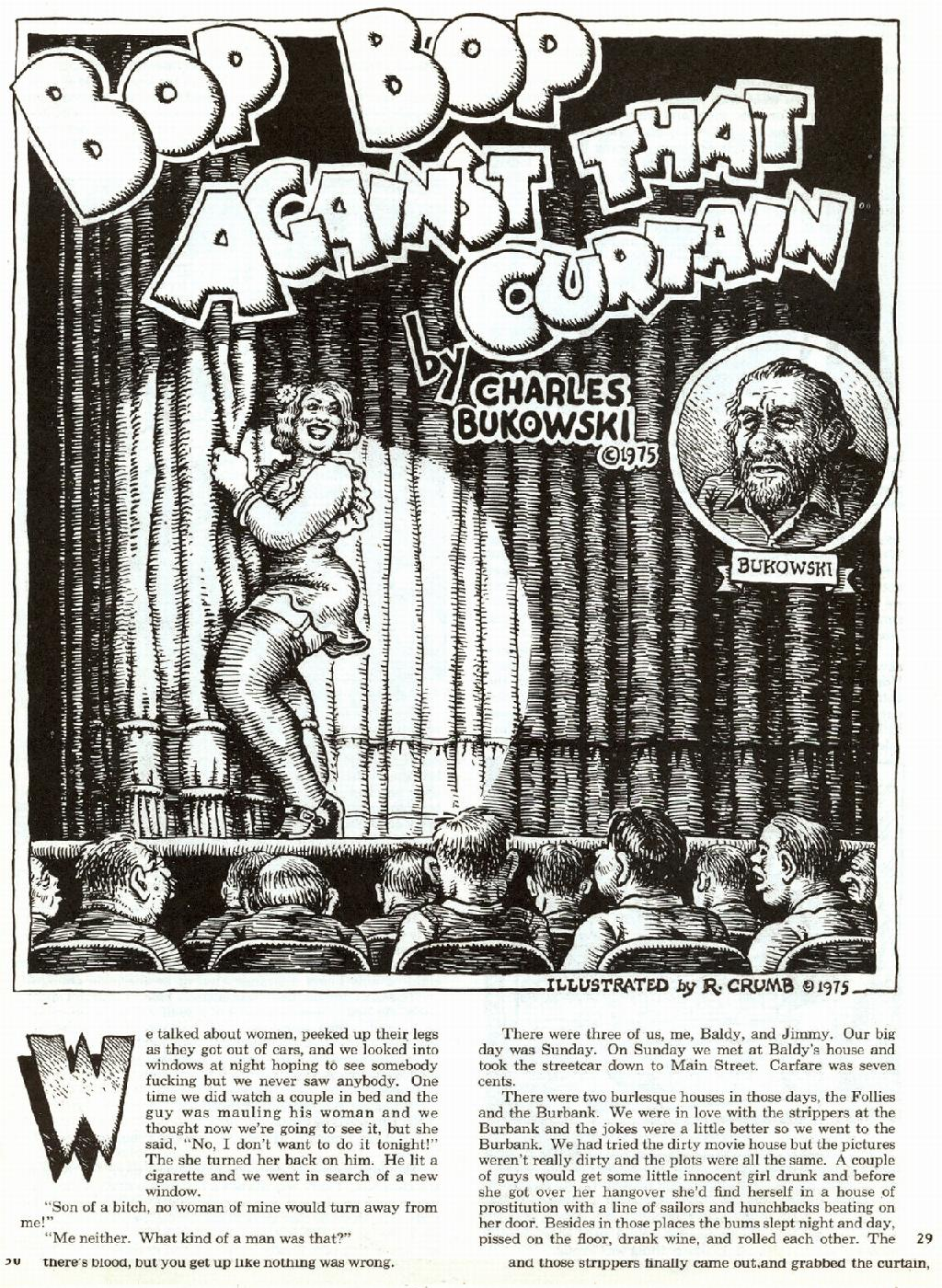
Bop Bop Against That Curtain by Charles Bukowski is from the fall 1975 issue of Arcade, The Comics Review #3, complete with Robert Crumb illustrations.
We talked about women, peeked up their legs as they got out of cars, and we looked into windows at night hoping to see somebody fucking but we never saw anybody. One time we did watch a couple in bed and the guy was mauling his woman and we thought now we’re going to see it, but she said, “No, I don’t want to do it tonight!” Then she turned her back on him. He lit a cigarette and we went in search of a new window.
“Son of a bitch, no woman of mine would turn away from me!”
“Me neither. What kind of a man was that?”
There were three of us, me, Baldy, and Jimmy. Our big day was Sunday. On Sunday we met at Baldy’s house and took the streetcar down to Main Street. Carfare was seven cents.
There were two burlesque houses in those days, the Follies and the Burbank. We were in love with the strippers at the Burbank and the jokes were a little better so we went to the Burbank. We had tried the dirty movie house but the pictures weren’t really dirty and the plots were all the same. A couple of guys would get some little innocent girl drunk and before she got over her hangover she’d find herself in a house of prostitution with a line of sailors and hunchbacks beating on her door. Besides in those places the bums slept night and day, pissed on the floor, drank wine, and rolled each other. The stink of piss and wine and murder was unbearable. We went to the Burbank.
“You boys going to a burlesque today?” Baldy’s grampa would ask.
“Hell no, sir, we’ve got things to do.”
We went. We went each Sunday. We went early in the morning, long before the show and we walked up and down Main Street
looking into the empty bars where the B-girls sat in the doorways with their skirts up, kicking their ankles in the sunlight that drifted into the dark bar. The girls looked good. But we knew. We had heard. A guy went in for a drink and they charged his ass off, both for his drink and the girl’s. But the girl’s drink would be watered. You’d get a feel or two and that was it. If you showed any money the barkeep would see it and along would come the mickey and you were out over the bar and your money was gone. We knew.
After our walk along Main Street we’d go into the hotdog place and get our eight cent hotdog and our big nickel mug of rootbeer. We were lifting weights and our muscles bulged and we wore our sleeves rolled high and we each had a pack of cigarettes in our breast pocket. We even had tried a Charles Atlas course. Dynamic Tension, but lifting weights seemed the more rugged and obvious way.
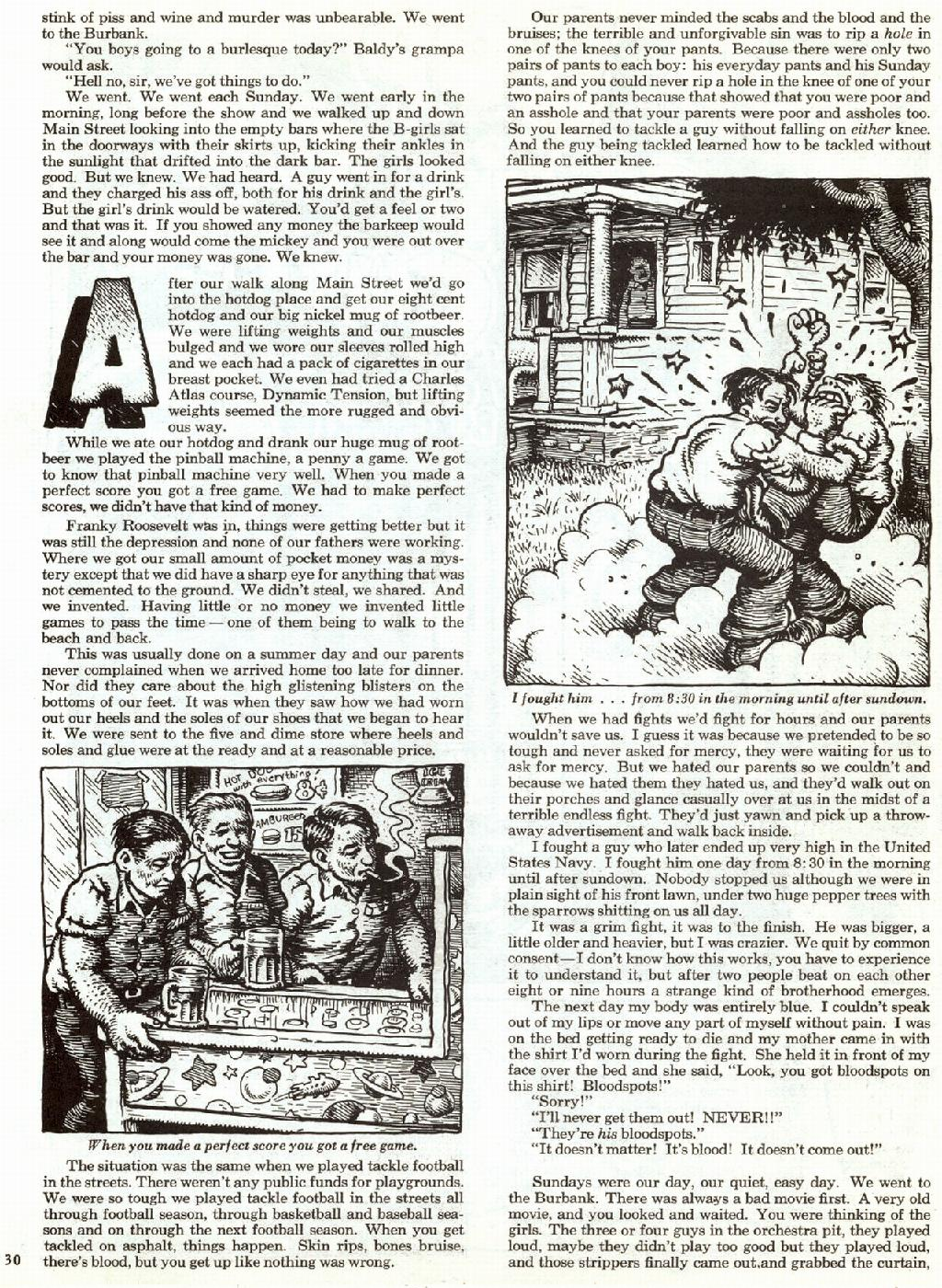
While we ate our hotdog and drank our huge mug of rootbeer we played the pinball machine, a penny a game. We got to know that pinball machine very well. When you made a perfect score you got a free game. We had to make perfect scores, we didn’t have that kind of money.
Franky Roosevelt was in, things were getting better but it was still the depression and none of our fathers were working. Where we got our small amount of pocket money was a mystery except that we did have a sharp eye for anything that was not cemented to the ground. We didn’t steal, we shared. And we invented. Having little or no money we invented little games to pass the time— one of them being to walk to the beach and back.
This was usually done on a summer day and our parents never complained when we arrived home too late for dinner. Nor did they care about the high glistening blisters on the bottoms of our feet. It was when they saw how we had worn out our heels and the soles of our shoes that we began to hear it. We were sent to the five and dime store where heels and soles and glue were at the ready and at a reasonable price.
The situation was the same when we played tackle football in the streets. There weren’t any public funds for playgrounds. We were so tough we played tackle football in the streets all through football season, through basketball and baseball seasons and on through the next football season. When you get tackled on asphalt, things happen. Skin rips, bones bruise, there’s blood, but you get up like nothing was wrong.
Our parents never minded the scabs and the blood and the bruises; the terrible and unforgivable sin was to rip a hole in one of the knees of your pants. Because there were only two pairs of pants to each boy: his everyday pants and his Sunday pants, and you could never rip a hole in the knee of one of your two pairs of pants because that showed that you were poor and an asshole and that your parents were poor and assholes too. So you learned to tackle a guy without falling on either knee. And the guy being tackled learned how to be tackled without falling on either knee.
When we had fights we’d fight for hours and our parents wouldn’t save us. I guess it was because we pretended to be so tough and never asked for mercy, they were waiting for us to ask for mercy. But we hated our parents so we couldn’t and because we hated them they hated us, and they’d walk out on their porches and glance casually over at us in the midst of a terrible endless fight. They’d just yawn and pick up a throw-away advertisement and walk back inside.
I fought a guy who later ended up very high in the United States Navy. I fought him one day from 8:30 in the morning until after sundown. Nobody stopped us although we were in plain sight of his front lawn, under two huge pepper trees with the sparrows shit-ting on us all day.
It was a grim fight, it was to the finish. He was bigger, a little older and heavier, but I was crazier. We quit by common consent— I don’t know how this works, you have to experience it to understand it, but after two people beat on each other eight or nine hours a strange kind of brotherhood emerges.
The next day my body was entirely blue. I couldn’t speak out of my lips or move any part of myself without pain. I was on the bed getting ready to die and my mother came in with the shirt I’d worn during the fight. She held it in front of my face over the bed and she said, “Look, you got bloodspots on this shirt! Bloodspots!”
“Sorry!”
“I’ll never get them out! NEVER!!”
“They’re his bloodspots.”
“It doesn’t matter! It’s blood! It doesn’t come out!”
Sundays were our day, our quiet, easy day. We went to the Bur-bank. There was always a bad movie first. A very old movie, and you looked and waited. You were thinking of the girls. The three or four guys in the orchestra pit, they played loud, maybe they didn’t play too good but they played loud, and those strippers finally came out and grabbed the curtain, the edge of the curtain, and they grabbed that curtain like it was a man and shook their bodies and went bop bop bop against that curtain. Then they swung out and started to strip. If you had enough money there was even a bag of popcorn; if you didn’t to hell with it.
Before the next act there was an intermission. A little man got up and said, “Ladies and gentlemen, if you will let me have your kind attention . . .” He was selling peep-rings. In the glass of each ring, if you held it to the light there was a most wonderful picture. This was promised you! Each ring was only 50 cents, a lifetime possession for just 50 cents, made available only to the patrons of the Burbank and not sold anywhere else. “Just hold it up to the light and you will see! And, thank you, ladies and gentlemen, for your kind attention. Now the ushers will pass down the aisles among you.”
Two ragass bums would proceed down the aisles smelling of muscatel, each carrying a bag of peep-rings. I never saw anybody purchase one of the rings. I imagine, though, if you had held one up to the light the picture in the glass would have been a naked woman.
The band began again and the curtains opened and there was the chorus line, most of them former strippers gone old, heavy with mascara and rouge and lipstick, false eyelashes. They did their damndest to stay with the music but they were always a little behind. But they carried on; I thought they were very brave.

Then came the male singer. It was very difficult to like the male singer. He sang too loud about love gone wrong. He didn’t know how to sing and when he finished he spread his arms, and bowed his head to the tiniest ripple of applause.
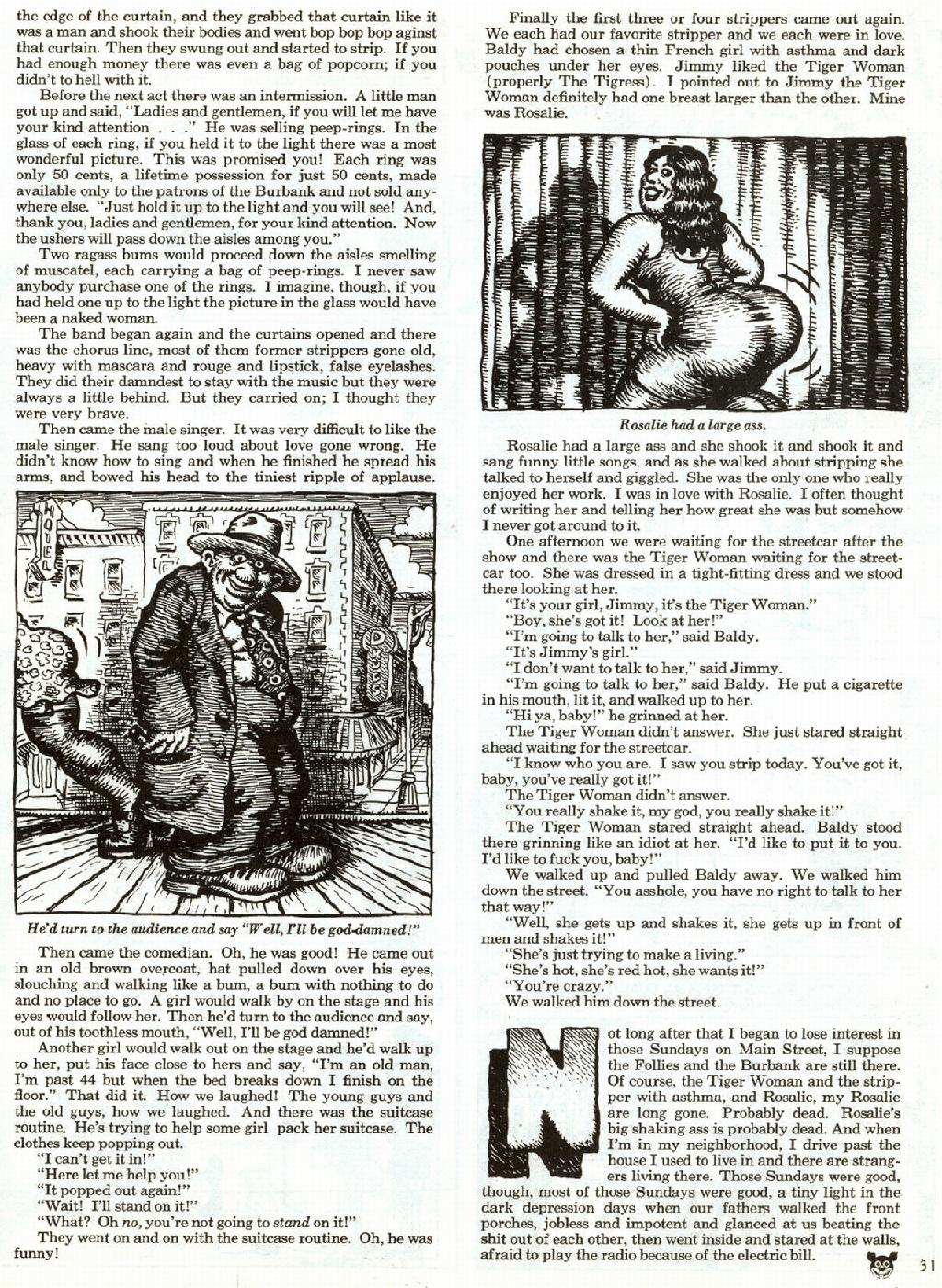
Then came the comedian. Oh, he was good! He came out in an old brown overcoat, hat pulled down over his eyes, slouching and walking like a bum, a bum with nothing to do and no place to go. A girl would walk by on the stage and his eyes would follow her. Then he’d turn to the audience and say, out of his toothless mouth, “Well, I’ll be god damned!”
Another girl would walk out on the stage and he’d walk up to her, put his face close to hers and say, “I’m an old man, I’m past 44 but when the bed breaks down I finish on the floor.” That did it. How we laughed! The young guys and the old guys, how we laughed. And there was the suitcase routine. He’s trying to help some girl pack her suitcase. The clothes keep popping out.
“I can’t get it in!”
“Here let me help you!”
“It popped out again!”
“Wait! I’ll stand on it!”
“What? Oh no, you’re not going to stand on it!”
They went on and on with the suitcase routine. Oh, he was funny!
Finally the first three or four strippers came out again. We each had our favorite stripper and we each were in love. Baldy had chosen a thin French girl with asthma and dark pouches under her eyes. Jimmy liked the Tiger Woman (properly The Tigress). I pointed out to Jimmy the Tiger Woman definitely had one breast larger than the other. Mine was Rosalie.
Rosalie had a large ass and she shook it and shook it and sang funny little songs, and as she walked about stripping she talked to herself and giggled. She was the only one who really enjoyed her work. I was in love with Rosalie. I often thought of writing her and telling her how great she was but somehow I never got around to it.
One afternoon we were waiting for the streetcar after the show and there was the Tiger Woman waiting for the streetcar too. She was dressed in a tight-fitting green dress and we stood there looking at her.
“It’s your girl, Jimmy, it’s the Tiger Woman.”
“Boy, she’s got it! Look at her!”
“I’m going to talk to her,” said Baldy.
“It’s Jimmy’s girl.”
“I don’t want to talk to her,” said Jimmy.
“I’m going to talk to her,” said Baldy. He put a cigarette in his mouth, lit it, and walked up to her.
“Hi ya, baby!” he grinned at her.
The Tiger Woman didn’t answer. She just stared straight ahead waiting for the streetcar.
“I know who you are. I saw you strip today. You’ve got it, baby, you’ve really got it!”
The Tiger Woman didn’t answer.
“You really shake it, my god, you really shake it!”
The Tiger Woman stared straight ahead. Baldy stood there grin-
ning like an idiot at her. “I’d like to put it to you. I’d like to fuck you, baby!”
We walked up and pulled Baldy away. We walked him down the street. “You asshole, you have no right to talk to her that way!”
“Well, she gets up and shakes it, she gets up in front of men and shakes it!”
“She’s just trying to make a living.”
“She’s hot, she’s red hot, she wants it!”
“You’re crazy.”
We walked him down the street.
Not long after that I began to lose interest in those Sundays on Main Street. I suppose the Follies and the Burbank are still there. Of course, the Tiger Woman and the stripper with asthma, and Rosalie, my Rosalie are long gone. Probably dead. Rosalie’s big shaking ass is probably dead. And when I’m in my neighborliood, I drive past the house I used to live in and there are strangers living there. Those Sundays were good, though, most of those Sundays were good, a tiny light in the dark depression days when our fathers walked the front porches, jobless and impotent and glanced at us beating the shit out of each other, then went inside and stared at the walls, afraid to play the radio because of the electric bill.
Bukowski is also well-known for his poetry. Find out more at poetryfoundation.org
Think maybe you’ve got the writing bug, too? REAL WRITER’S MARKET has over 500 publishers and 800 Imprints! Submissions now open. Check it out…

Thanks to the Bukowski Forum.
Discover more from Flashbytes
Subscribe to get the latest posts sent to your email.


