Anton Chekhov’s The Lady with the Dog is a nuanced short story about Dmitri Gurov, a disillusioned married banker, and Anna Sergeyevna, a young married woman, who begin an affair while vacationing in Yalta. What starts as a casual fling transforms into deep, mutual love, forcing them to confront the emptiness of their conventional lives and the challenges of sustaining a secret relationship
Published in 1899, The Lady with the Pet Dog is one of Chekhov’s defining works. The circumstances in which Chekhov wrote ‘The Lady and the Pet Dog’ are somewhat reflected in the setting of the story. In 1898 Chekhov had, for health reasons, moved from Moscow to the seaside resort of Yalta (in the Crimea). In doing so, he also had to leave the woman who would later become his wife, Olga Knipper, behind.
Anton Pavlovich Chekhov was a Russian playwright and short story writer, widely considered one of the greatest writers of all time. His career as a playwright produced four classics, and his best short stories are held in high esteem by writers and critics.
Enjoy
 The Lady With The Toy Dog By Anton Chekhov
It was reported that a new face had been seen on the quay;
a lady with a little dog. Dimitri Dimitrich Gomov, who had
been a fortnight at Talta and had got used to it, had begun
to show an interest in new faces. As he sat in the pavilion
at Verné’s he saw a young lady, blond and fairly tall, and
wearing a broad-brimmed hat, pass along the quay. After
her ran a white Pomeranian.
Later he saw her in the park and in the square several times
a day. She walked by herself, always in the same broadbrimmed hat, and with this white dog. Nobody knew who
she was, and she was spoken of as the lady with the toy
dog.
“If,” thought Gomov, “if she is here without a husband or a
friend, it would be as well to make her acquaintance.”
He was not yet forty, but he had a daughter of twelve and
two boys at school. He had married young, in his second
year at the University, and now his wife seemed half as old
again as himself. She was a tall woman, with dark
eyebrows, erect, grave, stolid, and she thought herself an
intellectual woman. She read a great deal, called her
husband not Dimitri, but Demitri, and in his private mind
he thought her short-witted, narrow-minded, and
ungracious. He was afraid of her and disliked being at
home. He had begun to betray her with other women long
ago, betrayed her frequently, and, probably for that reason
nearly always spoke ill of women, and when they were
discussed in his presence he would maintain that they were
an inferior race.
It seemed to him that his experience was bitter enough to
give him the right to call them any name he liked, but he
could not live a couple of days without the “inferior race.”
With men he was bored and ill at ease, cold and unable to
talk, but when he was with women, he felt easy and knew
what to talk about, and how to behave, and even when he
was silent with them he felt quite comfortable. In his
appearance as in his character, indeed in his whole nature,
there was something attractive, indefinable, which drew
women to him and charmed them; he knew it, and he, too,
was drawn by some mysterious power to them.
His frequent, and, indeed, bitter experiences had taught
him long ago that every affair of that kind, at first a divine
diversion, a delicious smooth adventure, is in the end a
source of worry for a decent man, especially for men like
those at Moscow who are slow to move, irresolute,
domesticated, for it becomes at last an acute and
extraordinary complicated problem and a nuisance. But
whenever he met and was interested in a new woman, then
his experience would slip away from his memory, and he
would long to live, and everything would seem so simple
and amusing.
And it so happened that one evening he dined in the
gardens, and the lady in the broad-brimmed hat came up at
a leisurely pace and sat at the next table. Her expression,
her gait, her dress, her coiffure told him that she belonged
to society, that she was married, that she was paying her
first visit to Talta, that she was alone, and that she was
bored…. There is a great deal of untruth in the gossip about
the immorality of the place. He scorned such tales,
knowing that they were for the most part concocted by
people who would be only too ready to sin if they had the
chance, but when the lady sat down at the next table, only
a yard or two away from him, his thoughts were filled with
tales of easy conquests, of trips to the mountains; and he
was suddenly possessed by the alluring idea of a quick
transitory liaison, a moment’s affair with an unknown
woman whom he knew not even by name.
He beckoned to the little dog, and when it came up to him,
wagged his finger at it. The dog began to growl. Gomov
again wagged his finger.
The lady glanced at him and at once cast her eyes down.
“He won’t bite,” she said and blushed.
“May I give him a bone?”–and when she nodded
emphatically, he asked affably: “Have you been in Talta
long?”
“About five days.”
“And I am just dragging through my second week.”
They were silent for a while.
“Time goes quickly,” she said, “and it is amazingly boring
here.”
“It is the usual thing to say that it is boring here. People
live quite happily in dull holes like Bieliev or Zhidra, but
as soon as they come here they say: ‘How boring it is! The
very dregs of dullness!’ One would think they came from
Spain.”
She smiled. Then both went on eating in silence as though
they did not know each other; but after dinner they went
off together–and then began an easy, playful conversation
as though they were perfectly happy, and it was all one to
them where they went or what they talked of. They walked
and talked of how the sea was strangely luminous; the
water lilac, so soft and warm, and athwart it the moon cast
a golden streak. They said how stifling it was after the hot
day. Gomov told her how he came from Moscow and was
a philologist by education, but in a bank by profession; and
how he had once wanted to sing in opera, but gave it up;
and how he had two houses in Moscow…. And from her he
learned that she came from Petersburg, was born there, but
married at S. where she had been living for the last two
years; that she would stay another month at Talta, and
2
perhaps her husband would come for her, because, he too,
needed a rest. She could not tell him what her husband
was–Provincial Administration or Zemstvo Council–and
she seemed to think it funny. And Gomov found out that
her name was Anna Sergueyevna.
In his room at night, he thought of her and how they would
meet next day. They must do so. As he was going to sleep,
it struck him that she could only lately have left school,
and had been at her lessons even as his daughter was then;
he remembered how bashful and gauche she was when she
laughed and talked with a stranger–it must be, he thought,
the first time she had been alone, and in such a place with
men walking after her and looking at her and talking to
her, all with the same secret purpose which she could not
but guess. He thought of her slender white neck and her
pretty, grey eyes.
“There is something touching about her,” he thought as he
began to fall asleep.
II
A week passed. It was a blazing day. Indoors it was
stifling, and in the streets the dust whirled along. All day
long he was plagued with thirst and he came into the
pavilion every few minutes and offered Anna Sergueyevna
an iced drink or an ice. It was impossibly hot.
In the evening, when the air was fresher, they walked to
the jetty to see the steamer come in. There was quite a
crowd all gathered to meet somebody, for they carried
bouquets. And among them were clearly marked the
peculiarities of Talta: the elderly ladies were youngly
dressed and there were many generals.
The sea was rough and the steamer was late, and before it
turned into the jetty it had to do a great deal of
manoeuvring. Anna Sergueyevna looked through her
lorgnette at the steamer and the passengers as though she
were looking for friends, and when she turned to Gomov,
her eyes shone. She talked much and her questions were
abrupt, and she forgot what she had said; and then she lost
her lorgnette in the crowd.
The well-dressed people went away, the wind dropped,
and Gomov and Anna Sergueyevna stood as though they
were waiting for somebody to come from the steamer.
Anna Sergueyevna was silent. She smelled her flowers and
did not look at Gomov.
“The weather has got pleasanter toward evening,” he said.
“Where shall we go now? Shall we take a carriage?”
She did not answer.
He fixed his eyes on her and suddenly embraced her and
kissed her lips, and he was kindled with the perfume and
the moisture of the flowers; at once he started and looked
round; had not some one seen?
“Let us go to your–” he murmured.
And they walked quickly away.
Her room was stifling, and smelled of scents which she
had bought at the Japanese shop. Gomov looked at her and
thought: “What strange chances there are in life!” From the
past there came the memory of earlier good-natured
women, gay in their love, grateful to him for their
happiness, short though it might be; and of others–like his
wife–who loved without sincerity, and talked overmuch
and affectedly, hysterically, as though they were protesting
that it was not love, nor passion, but something more
important; and of the few beautiful cold women, into
whose eyes there would flash suddenly a fierce expression,
a stubborn desire to take, to snatch from life more than it
can give; they were no longer in their first youth, they
were capricious, unstable, domineering, imprudent, and
when Gomov became cold toward them then their beauty
roused him to hatred, and the lace on their lingerie
reminded him of the scales of fish.
But here there was the shyness and awkwardness of
inexperienced youth, a feeling of constraint; an impression
of perplexity and wonder, as though some one had
suddenly knocked at the door. Anna Sergueyevna, “the
lady with the toy dog” took what had happened somehow
seriously, with a particular gravity, as though thinking that
this was her downfall and very strange and improper. Her
features seemed to sink and wither, and on either side of
her face her long hair hung mournfully down; she sat
crestfallen and musing, exactly like a woman taken in sin
in some old picture.
“It is not right,” she said. “You are the first to lose respect
for me.”
There was a melon on the table. Gomov cut a slice and
began to eat it slowly. At least half an hour passed in
silence.
Anna Sergueyevna was very touching; she irradiated the
purity of a simple, devout, inexperienced woman; the
solitary candle on the table hardly lighted her face, but it
showed her very wretched.
“Why should I cease to respect you?” asked Gomov. “You
don’t know what you are saying.”
“God forgive me!” she said, and her eyes filled with tears.
“It is horrible.”
“You seem to want to justify yourself.”
“How can I justify myself? I am a wicked, low woman and
I despise myself. I have no thought of justifying myself. It
is not my husband that I have deceived, but myself. And
not only now but for a long time past. My husband may be
a good honest man, but he is a lackey. I do not know what
3
work he does, but I do know that he is a lackey in his soul.
I was twenty when I married him. I was overcome by
curiosity. I longed for something. ‘Surely,’ I said to myself,
‘there is another kind of life.’ I longed to live! To live, and
to live…. Curiosity burned me up…. You do not understand
it, but I swear by God, I could no longer control myself.
Something strange was going on in me. I could not hold
myself in. I told my husband that I was ill and came here….
And here I have been walking about dizzily, like a
lunatic…. And now I have become a low, filthy woman
whom everybody may despise.”
Gomov was already bored; her simple words irritated him
with their unexpected and inappropriate repentance; but for
the tears in her eyes he might have thought her to be joking
or playing a part.
“I do not understand,” he said quietly. “What do you
want?”
She hid her face in his bosom and pressed close to him.
“Believe, believe me, I implore you,” she said. “I love a
pure, honest life, and sin is revolting to me. I don’t know
myself what I am doing. Simple people say: ‘The devil
entrapped me,’ and I can say of myself: ‘The Evil One
tempted me.'”
“Don’t, don’t,” he murmured.
He looked into her staring, frightened eyes, kissed her,
spoke quietly and tenderly, and gradually quieted her and
she was happy again, and they both began to laugh.
Later, when they went out, there was not a soul on the
quay; the town with its cypresses looked like a city of the
dead, but the sea still roared and broke against the shore; a
boat swung on the waves; and in it sleepily twinkled the
light of a lantern.
They found a cab and drove out to the Oreanda.
“Just now in the hall,” said Gomov, “I discovered your
name written on the board–von Didenitz. Is your husband
a German?”
“No. His grandfather, I believe, was a German, but he
himself is an Orthodox Russian.”
At Oreanda they sat on a bench, not far from the church,
looked down at the sea and were silent. Talta was hardly
visible through the morning mist. The tops of the hills
were shrouded in motionless white clouds. The leaves of
the trees never stirred, the cicadas trilled, and the
monotonous dull sound of the sea, coming up from below,
spoke of the rest, the eternal sleep awaiting us. So the sea
roared when there was neither Talta nor Oreanda, and so it
roars and will roar, dully, indifferently when we shall be
no more. And in this continual indifference to the life and
death of each of us, lives pent up, the pledge of our eternal
salvation, of the uninterrupted movement of life on earth
and its unceasing perfection. Sitting side by side with a
young woman, who in the dawn seemed so beautiful,
Gomov, appeased and enchanted by the sight of the fairy
scene, the sea, the mountains, the clouds, the wide sky,
thought how at bottom, if it were thoroughly explored,
everything on earth was beautiful, everything, except what
we ourselves think and do when we forget the higher
purposes of life and our own human dignity.
A man came up–a coast-guard–gave a look at them, then
went away. He, too, seemed mysterious and enchanted. A
steamer came over from Feodossia, by the light of the
morning star, its own lights already put out.
“There is dew on the grass,” said Anna Sergueyevna after a
silence.
“Yes. It is time to go home.”
They returned to the town.
Then every afternoon they met on the quay, and lunched
together, dined, walked, enjoyed the sea. She complained
that she slept badly, that her heart beat alarmingly. She
would ask the same question over and over again, and was
troubled now by jealousy, now by fear that he did not
sufficiently respect her. And often in the square or the
gardens, when there was no one near, he would draw her
close and kiss her passionately. Their complete idleness,
these kisses in the full daylight, given timidly and fearfully
lest any one should see, the heat, the smell of the sea and
the continual brilliant parade of leisured, well-dressed,
well-fed people almost regenerated him. He would tell
Anna Sergueyevna how delightful she was, how tempting.
He was impatiently passionate, never left her side, and she
would often brood, and even asked him to confess that he
did not respect her, did not love her at all, and only saw in
her a loose woman. Almost every evening, rather late, they
would drive out of the town, to Oreanda, or to the
waterfall; and these drives were always delightful, and the
impressions won during them were always beautiful and
sublime.
They expected her husband to come. But he sent a letter in
which he said that his eyes were bad and implored his wife
to come home. Anna Sergueyevna began to worry.
“It is a good thing I am going away,” she would say to
Gomov. “It is fate.”
She went in a carriage and he accompanied her. They
drove for a whole day. When she took her seat in the car of
an express-train and when the second bell sounded, she
said:
“Let me have another look at you…. Just one more look.
Just as you are.”
4
She did not cry, but was sad and low-spirited, and her lips
trembled.
“I will think of you–often,” she said. “Good-bye. Goodbye. Don’t think ill of me. We part for ever. We must,
because we ought not to have met at all. Now, good-bye.”
The train moved off rapidly. Its lights disappeared, and in
a minute or two the sound of it was lost, as though
everything were agreed to put an end to this sweet,
oblivious madness. Left alone on the platform, looking
into the darkness, Gomov heard the trilling of the
grasshoppers and the humming of the telegraph-wires, and
felt as though he had just woke up. And he thought that it
had been one more adventure, one more affair, and it also
was finished and had left only a memory. He was moved,
sad, and filled with a faint remorse; surely the young
woman, whom he would never see again, had not been
happy with him; he had been kind to her, friendly, and
sincere, but still in his attitude toward her, in his tone and
caresses, there had always been a thin shadow of raillery,
the rather rough arrogance of the successful male
aggravated by the fact that he was twice as old as she. And
all the time she had called him kind, remarkable, noble, so
that he was never really himself to her, and had
involuntarily deceived her….
Here at the station, the smell of autumn was in the air, and
the evening was cool.
“It is time for me to go North,” thought Gomov, as he left
the platform. “It is time.”
III
At home in Moscow, it was already like winter; the stoves
were heated, and in the mornings, when the children were
getting ready to go to school, and had their tea, it was dark
and their nurse lighted the lamp for a short while. The frost
had already begun. When the first snow falls, the first day
of driving in sledges, it is good to see the white earth, the
white roofs; one breathes easily, eagerly, and then one
remembers the days of youth. The old lime-trees and
birches, white with hoarfrost, have a kindly expression;
they are nearer to the heart than cypresses and palm-trees,
and with the dear familiar trees there is no need to think of
mountains and the sea.
Gomov was a native of Moscow. He returned to Moscow
on a fine frosty day, and when he donned his fur coat and
warm gloves, and took a stroll through Petrovka, and when
on Saturday evening he heard the church-bells ringing,
then his recent travels and the places he had visited lost all
their charm. Little by little he sank back into Moscow life,
read eagerly three newspapers a day, and said that he did
not read Moscow papers as a matter of principle. He was
drawn into a round of restaurants, clubs, dinner-parties,
parties, and he was flattered to have his house frequented
by famous lawyers and actors, and to play cards with a
professor at the University club. He could eat a whole
plateful of hot _sielianka_.
So a month would pass, and Anna Sergueyevna, he
thought, would be lost in the mists of memory and only
rarely would she visit his dreams with her touching smile,
just as other women had done. But more than a month
passed, full winter came, and in his memory everything
was clear, as though he had parted from Anna
Sergueyevna only yesterday. And his memory was lit by a
light that grew ever stronger. No matter how, through the
voices of his children saying their lessons, penetrating to
the evening stillness of his study, through hearing a song,
or the music in a restaurant, or the snow-storm howling in
the chimney, suddenly the whole thing would come to life
again in his memory: the meeting on the jetty, the early
morning with the mists on the mountains, the steamer from
Feodossia and their kisses. He would pace up and down his
room and remember it all and smile, and then his
memories would drift into dreams, and the past was
confused in his imagination with the future. He did not
dream at night of Anna Sergueyevna, but she followed him
everywhere, like a shadow, watching him. As he shut his
eyes, he could see her, vividly, and she seemed handsomer,
tenderer, younger than in reality; and he seemed to himself
better than he had been at Talta. In the evenings she would
look at him from the bookcase, from the fireplace, from
the corner; he could hear her breathing and the soft rustle
of her dress. In the street he would gaze at women’s faces
to see if there were not one like her….
He was filled with a great longing to share his memories
with some one. But at home it was impossible to speak of
his love, and away from home–there was no one.
Impossible to talk of her to the other people in the house
and the men at the bank. And talk of what? Had he loved
then? Was there anything fine, romantic, or elevating or
even interesting in his relations with Anna Sergueyevna?
And he would speak vaguely of love, of women, and
nobody guessed what was the matter, and only his wife
would raise her dark eyebrows and say:
“Demitri, the rôle of coxcomb does not suit you at all.”
One night, as he was coming out of the club with his
partner, an official, he could not help saying:
“If only I could tell what a fascinating woman I met at
Talta.”
The official seated himself in his sledge and drove off, but
suddenly called:
“Dimitri Dimitrich!”
“Yes.”
“You were right. The sturgeon was tainted.”
5
These banal words suddenly roused Gomov’s indignation.
They seemed to him degrading and impure. What
barbarous customs and people!
What preposterous nights, what dull, empty days! Furious
card-playing, gourmandising, drinking, endless
conversations about the same things, futile activities and
conversations taking up the best part of the day and all the
best of a man’s forces, leaving only a stunted, wingless life,
just rubbish; and to go away and escape was impossible–
one might as well be in a lunatic asylum or in prison with
hard labour.
Gomov did not sleep that night, but lay burning with
indignation, and then all next day he had a headache. And
the following night he slept badly, sitting up in bed and
thinking, or pacing from corner to corner of his room. His
children bored him, the bank bored him, and he had no
desire to go out or to speak to any one.
In December when the holidays came he prepared to go on
a journey and told his wife he was going to Petersburg to
present a petition for a young friend of his–and went to S.
Why? He did not know. He wanted to see Anna
Sergueyevna, to talk to her, and if possible to arrange an
assignation.
He arrived at S. in the morning and occupied the best room
in the hotel, where the whole floor was covered with a
grey canvas, and on the table there stood an inkstand grey
with dust, adorned with a horseman on a headless horse
holding a net in his raised hand. The porter gave him the
necessary information: von Didenitz; Old Goucharno
Street, his own house–not far from the hotel; lives well,
has his own horses, every one knows him.
Gomov walked slowly to Old Goucharno Street and found
the house. In front of it was a long, grey fence spiked with
nails.
“No getting over a fence like that,” thought Gomov,
glancing from the windows to the fence.
He thought: “To-day is a holiday and her husband is
probably at home. Besides it would be tactless to call and
upset her. If he sent a note then it might fall into her
husband’s hands and spoil everything. It would be better to
wait for an opportunity.” And he kept on walking up and
down the street, and round the fence, waiting for his
opportunity. He saw a beggar go in at the gate and the dogs
attack him. He heard a piano and the sounds came faintly
to his ears. It must be Anna Sergueyevna playing. The
door suddenly opened and out of it came an old woman,
and after her ran the familiar white Pomeranian. Gomov
wanted to call the dog, but his heart suddenly began to
thump and in his agitation he could not remember the dog’s
name.
He walked on, and more and more he hated the grey fence
and thought with a gust of irritation that Anna
Sergueyevna had already forgotten him, and was perhaps
already amusing herself with some one else, as would be
only natural in a young woman forced from morning to
night to behold the accursed fence. He returned to his room
and sat for a long time on the sofa, not knowing what to
do. Then he dined and afterward slept for a long while.
“How idiotic and tiresome it all is,” he thought as he
awoke and saw the dark windows; for it was evening. “I’ve
had sleep enough, and what shall I do to-night?”
He sat on his bed which was covered with a cheap, grey
blanket, exactly like those used in a hospital, and
tormented himself.
“So much for the lady with the toy dog…. So much for the
great adventure…. Here you sit.”
However, in the morning, at the station, his eye had been
caught by a poster with large letters: “First Performance of
‘The Geisha.'” He remembered that and went to the theatre.
“It is quite possible she will go to the first performance,”
he thought.
The theatre was full and, as usual in all provincial theatres,
there was a thick mist above the lights, the gallery was
noisily restless; in the first row before the opening of the
performance stood the local dandies with their hands
behind their backs, and there in the governor’s box, in
front, sat the governor’s daughter, and the governor himself
sat modestly behind the curtain and only his hands were
visible. The curtain quivered; the orchestra tuned up for a
long time, and while the audience were coming in and
taking their seats, Gomov gazed eagerly round.
At last Anna Sergueyevna came in. She took her seat in the
third row, and when Gomov glanced at her his heart ached
and he knew that for him there was no one in the whole
world nearer, dearer, and more important than she; she was
lost in this provincial rabble, the little undistinguished
woman, with a common lorgnette in her hands, yet she
filled his whole life; she was his grief, his joy, his only
happiness, and he longed for her; and through the noise of
the bad orchestra with its tenth-rate fiddles, he thought
how dear she was to him. He thought and dreamed.
With Anna Sergueyevna there came in a young man with
short side-whiskers, very tall, stooping; with every
movement he shook and bowed continually. Probably he
was the husband whom in a bitter mood at Talta she had
called a lackey. And, indeed, in his long figure, his sidewhiskers, the little bald patch on the top of his head, there
was something of the lackey; he had a modest sugary smile
and in his buttonhole he wore a University badge exactly
like a lackey’s number.
In the first entr’acte the husband went out to smoke, and
she was left alone. Gomov, who was also in the pit, came
up to her and said in a trembling voice with a forced smile:
6
“How do you do?”
She looked up at him and went pale. Then she glanced at
him again in terror, not believing her eyes, clasped her fan
and lorgnette tightly together, apparently struggling to
keep herself from fainting. Both were silent. She sat, he
stood; frightened by her emotion, not daring to sit down
beside her. The fiddles and flutes began to play and
suddenly it seemed to them as though all the people in the
boxes were looking at them. She got up and walked
quickly to the exit; he followed, and both walked absently
along the corridors, down the stairs, up the stairs, with the
crowd shifting and shimmering before their eyes; all kinds
of uniforms, judges, teachers, crown-estates, and all with
badges; ladies shone and shimmered before them, like fur
coats on moving rows of clothes-pegs, and there was a
draught howling through the place laden with the smell of
tobacco and cigar-ends. And Gomov, whose heart was
thudding wildly, thought:
“Oh, Lord! Why all these men and that beastly orchestra?”
At that very moment he remembered how when he had
seen Anna Sergueyevna off that evening at the station he
had said to himself that everything was over between
them, and they would never meet again. And now how far
off they were from the end!
On a narrow, dark staircase over which was written: “This
Way to the Amphitheatre,” she stopped:
“How you frightened me!” she said, breathing heavily, still
pale and apparently stupefied. “Oh! how you frightened
me! I am nearly dead. Why did you come? Why?”
“Understand me, Anna,” he whispered quickly. “I implore
you to understand….”
She looked at him fearfully, in entreaty, with love in her
eyes, gazing fixedly to gather up in her memory every one
of his features.
“I suffer so!” she went on, not listening to him. “All the
time, I thought only of you. I lived with thoughts of you….
And I wanted to forget, to forget, but why, why did you
come?”
A little above them, on the landing, two schoolboys stood
and smoked and looked down at them, but Gomov did not
care. He drew her to him and began to kiss her cheeks, her
hands.
“What are you doing? What are you doing?” she said in
terror, thrusting him away…. “We were both mad. Go
away to-night. You must go away at once…. I implore you,
by everything you hold sacred, I implore you…. The
people are coming—–”
Some one passed them on the stairs.
“You must go away,” Anna Sergueyevna went on in a
whisper. “Do you hear, Dimitri Dimitrich? I’ll come to you
in Moscow. I never was happy. Now I am unhappy and I
shall never, never be happy, never! Don’t make me suffer
even more! I swear, I’ll come to Moscow. And now let us
part. My dear, dearest darling, let us part!”
She pressed his hand and began to go quickly down-stairs,
all the while looking back at him, and in her eyes plainly
showed that she was most unhappy. Gomov stood for a
while, listened, then, when all was quiet he found his coat
and left the theatre.
IV
And Anna Sergueyevna began to come to him in Moscow.
Once every two or three months she would leave S., telling
her husband that she was going to consult a specialist in
women’s diseases. Her husband half believed and half
disbelieved her. At Moscow she would stay at the
“Slaviansky Bazaar” and send a message at once to
Gomov. He would come to her, and nobody in Moscow
knew.
Once as he was going to her as usual one winter morning–
he had not received her message the night before–he had
his daughter with him, for he was taking her to school
which was on the way. Great wet flakes of snow were
falling.
“Three degrees above freezing,” he said, “and still the
snow is falling. But the warmth is only on the surface of
the earth. In the upper strata of the atmosphere there is
quite a different temperature.”
“Yes, papa. Why is there no thunder in winter?”
He explained this too, and as he spoke he thought of his
assignation, and that not a living soul knew of it, or ever
would know. He had two lives; one obvious, which every
one could see and know, if they were sufficiently
interested, a life full of conventional truth and
conventional fraud, exactly like the lives of his friends and
acquaintances; and another, which moved underground.
And by a strange conspiracy of circumstances, everything
that was to him important, interesting, vital, everything
that enabled him to be sincere and denied self-deception
and was the very core of his being, must dwell hidden
away from others, and everything that made him false, a
mere shape in which he hid himself in order to conceal the
truth, as for instance his work in the bank, arguments at the
club, his favourite gibe about women, going to parties with
his wife–all this was open. And, judging others by
himself, he did not believe the things he saw, and assumed
that everybody else also had his real vital life passing
under a veil of mystery as under the cover of the night.
Every man’s intimate existence is kept mysterious, and
perhaps, in part, because of that civilised people are so
7
nervously anxious that a personal secret should be
respected.
When he had left his daughter at school, Gomov went to
the “Slaviansky Bazaar.” He took off his fur coat downstairs, went up and knocked quietly at the door. Anna
Sergueyevna, wearing his favourite grey dress, tired by the
journey, had been expecting him to come all night. She
was pale, and looked at him without a smile, and flung
herself on his breast as soon as he entered. Their kiss was
long and lingering as though they had not seen each other
for a couple of years.
“Well, how are you getting on down there?” he asked.
“What is your news?”
“Wait. I’ll tell you presently…. I cannot.”
She could not speak, for she was weeping. She turned her
face from him and dried her eyes.
“Well, let her cry a bit…. I’ll wait,” he thought, and sat
down.
Then he rang and ordered tea, and then, as he drank it, she
stood and gazed out of the window…. She was weeping in
distress, in the bitter knowledge that their life had fallen
out so sadly; only seeing each other in secret, hiding
themselves away like thieves! Was not their life crushed?
“Don’t cry…. Don’t cry,” he said.
It was clear to him that their love was yet far from its end,
which there was no seeing. Anna Sergueyevna was more
and more passionately attached to him; she adored him and
it was inconceivable that he should tell her that their love
must some day end; she would not believe it.
He came up to her and patted her shoulder fondly and at
that moment he saw himself in the mirror.
His hair was already going grey. And it seemed strange to
him that in the last few years he should have got so old and
ugly. Her shoulders were warm and trembled to his touch.
He was suddenly filled with pity for her life, still so warm
and beautiful, but probably beginning to fade and wither,
like his own. Why should she love him so much? He
always seemed to women not what he really was, and they
loved in him, not himself, but the creature of their
imagination, the thing they hankered for in life, and when
they had discovered their mistake, still they loved him.
And not one of them was happy with him. Time passed; he
met women and was friends with them, went further and
parted, but never once did he love; there was everything
but love.
And now at last when his hair was grey he had fallen in
love, real love–for the first time in his life.
Anna Sergueyevna and he loved one another, like dear
kindred, like husband and wife, like devoted friends; it
seemed to them that Fate had destined them for one
another, and it was inconceivable that he should have a
wife, she a husband; they were like two birds of passage, a
male and a female, which had been caught and forced to
live in separate cages. They had forgiven each other all the
past of which they were ashamed; they forgave everything
in the present, and they felt that their love had changed
both of them.
Formerly, when he felt a melancholy compunction, he
used to comfort himself with all kinds of arguments, just as
they happened to cross his mind, but now he was far
removed from any such ideas; he was filled with a
profound pity, and he desired to be tender and sincere….
“Don’t cry, my darling,” he said. “You have cried
enough…. Now let us talk and see if we can’t find some
way out.”
Then they talked it all over, and tried to discover some
means of avoiding the necessity for concealment and
deception, and the torment of living in different towns, and
of not seeing each other for a long time. How could they
shake off these intolerable fetters?
“How? How?” he asked, holding his head in his hands.
“How?”
And it seemed that but a little while and the solution would
be found and there would begin a lovely new life; and to
both of them it was clear that the end was still very far off,
and that their hardest and most difficult period was only
just beginning.
END
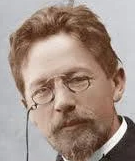 Anton Pavlovich Chekhov was a Russian playwright and short story writer, widely considered one of the greatest writers of all time. His career as a playwright produced four classics, and his best short stories are held in high esteem by writers and critics.
Come check out these other great indie publishers:
POST HILL Press Skyhorse Publishing Two Dollar Radio
Think maybe you’ve got the writing bug, too? REAL WRITER’S MARKET has over 500 publishers and 800 Imprints! Submissions now open. Check it out…
 Thank you and Happy Publishing…
#AntonPavlovichChekhov #TheToyDogbyAntonChekhov
Discover more from Flashbytes
Subscribe to get the latest posts sent to your email.


